Lukas Huber
Contributor
Forget 50-page business plans. With the Company DNA method, you'll have a clear, actionable AI plan for your SME in 2 hours - including a free template.
Key Takeaways
- ▸**Die Firmen-DNA** ist ein Ein-Seiten-Plan, der Ihre wichtigsten Geschäftsinformationen strukturiert - ideal für KI-Integration
- ▸**2-Stunden-Prozess**: Mit der Ping-Pong-Methode (Mensch fragt, KI antwortet, Mensch verfeinert) zum fertigen Plan
- ▸**Kostenlose Vorlage**: 9 Kernfragen zu Mission, Zielgruppe, Wertversprechen, Prozessen und Zielen
- ▸**Praxis-Beispiel**: Wie eine Schweizer Treuhand ihre Firmen-DNA in 90 Minuten erstellt hat
- ▸**Sofort umsetzbar**: Template downloaden, ausfüllen, als Basis für alle KI-Projekte nutzen
Why 50-Page Business Plans Fail (and What Works Instead)
The reality for many Swiss SMEs in 2026 is sobering: While global players and large corporations are investing heavily in artificial intelligence, the mid-sized sector often lags behind. According to a KOIIA report, only about 1% of the 12,000 domestic SMEs in the manufacturing sector have actually implemented and actively use AI technologies. This is often due to the same problems that hinder the adoption of other innovations: Companies want to implement AI, but where do they start? Most SMEs begin with:
- 📄 Monstrous strategy papers that gather dust in drawers and are read by no one.
- 🤷 Vague ideas like "We should do something with AI...", without clear goals or use cases.
- 🔧 Random tool purchases because a competitor is using it or there's a hype, without strategic integration.
The result: A vicious cycle of chaos, wasted budgets, and frustrated teams. This lack of strategic integration is a key reason why Europe – and thus Switzerland – risks falling behind in AI adoption compared to leading regions like China, as the Industry 4.0 Barometer 2026 shows. Outdated IT and OT landscapes are often hurdles, but the lack of data standardization and high investment costs are also deterrents.
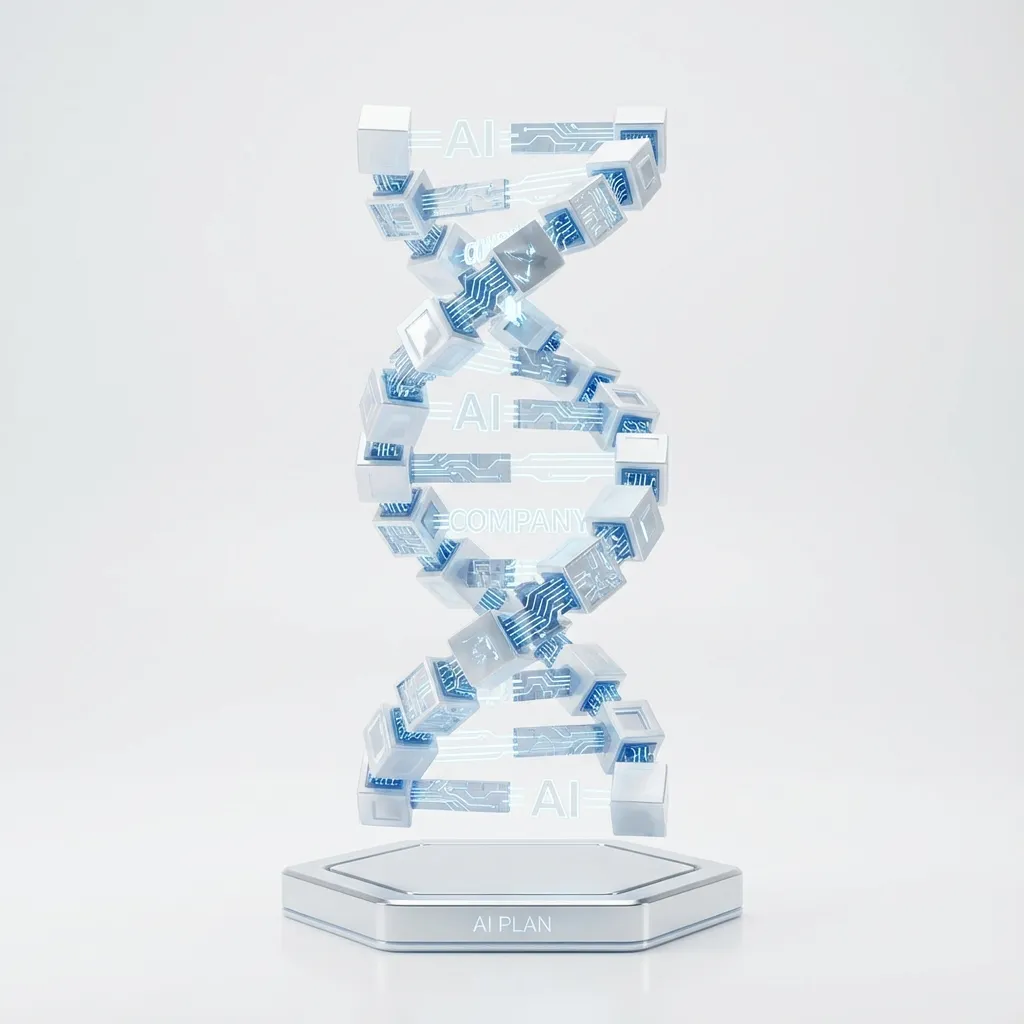
The solution to address these challenges and effectively integrate AI lies in clarity and focus: The Company DNA – a one-page plan that distills everything important about your business. This plan isn't for investors, but for *you*, your team, and most importantly, for any AI you intend to deploy. It creates the necessary context and structure that modern AI systems need to be truly useful.
💡 The Difference from Traditional Planning:
| Characteristic | Traditional Business Plan | Company DNA |
|---|---|---|
| Scope | 50+ pages | 1 page |
| Effort | 40+ hours | 2 hours |
| Usage | Gathers dust in a drawer | Used daily |
| Focus | External (Investors, Banks) | Internal (Team, AI Systems) |
| Adaptability | Rigid, complex | Flexible, iterative |
What is Company DNA? (And Why You Need One)
Company DNA is a structured, concise summary of your business on a single page. It serves as the ultimate context provider for every strategic decision, every communication measure, and especially for every interaction with artificial intelligence. It answers 9 core questions that form the foundation of your business and are often lost in the depths of lengthy strategy papers.
- Mission & Vision: Why does your company exist beyond pure profit? What is your long-term goal and what contribution do you make? A clear mission helps AI understand the overarching purpose of your requests and deliver results aligned with your identity.
- Target Audience: Who are your ideal customers? What demographics, needs, pain points, and behaviours define them? The more precise the definition, the more targeted AI can generate marketing copy, product ideas, or service suggestions.
- Value Proposition: What makes you unique and sets you apart from the competition? Why should customers choose you specifically? This unique selling proposition is crucial for AI to highlight your strengths and sharpen your messaging.
- Products/Services: What do you concretely offer? Briefly describe your main products or services. This information enables AI to create detailed descriptions, FAQs, or even sales scripts.
- Core Processes: How does your business operate? What steps are necessary from inquiry to delivery or service provision? Understanding your processes helps AI identify automation potential, optimize workflows, and highlight bottlenecks.
- Team & Roles: Who does what in your company? Which departments or key individuals are responsible for which areas? This knowledge is fundamental for assigning tasks via AI-powered project management tools or for personalizing internal communication.
- Current Challenges: Where are the biggest pain points? What problems urgently need solving? These insights are invaluable for AI systems to specifically search for solutions, analyze bottlenecks, or set priorities for automation.
- Goals (90 Days): What do you want to achieve next? Short-term, measurable goals keep you and your AI on track. They provide systems with clear direction for task support and optimization.
- Measuring Success: How do you recognise progress and success? Which KPIs are crucial? Clear measurement criteria enable AI to generate reports, analyze trends, and provide recommendations for achieving goals.
Why This is Important for AI:
Every AI tool, whether it's a language model like ChatGPT, Perplexity, Claude, or Gemini, or a specialized automation platform, performs exponentially better when it has comprehensive *context* about your business. Company DNA is this context – in a highly condensed, digestible, and immediately usable form. Without this context, AI is like a gifted child who can speak but doesn't know your world, thus only providing generic answers. With Company DNA, AI becomes an informed assistant that understands your specific needs and can act accordingly.
The importance of this context is also recognized by major players like OpenAI, who, with their "Frontier Alliances," support companies in the strategic integration of AI to unlock its full potential. A well-thought-out Company DNA is the first step towards this strategic integration, especially for SMEs that often struggle with a lack of data standardization. It provides the necessary foundation to effectively integrate AI systems into existing workflows and facilitate change management.
Practical Example: A Zurich-based marketing agency that consistently uses its Company DNA has found that the quality of its AI-generated content has drastically improved. They use their Company DNA as a "system prompt" in ChatGPT. The result: All texts sound authentic to the brand, match the desired tone, and target the audience, without the team having to repeat lengthy briefings every time. This not only saves time but also ensures consistent brand communication.
The Ping-Pong Method: Your Company DNA in 2 Hours
You don't need an expensive strategy weekend or external consultants to create your Company DNA. With our proven Ping-Pong Method, you can have your Company DNA ready in a maximum of 2 hours. This method leverages the strengths of modern AI language models to structure and precisely formulate your thoughts while you maintain control over the content.
Step 1: Preparation (10 minutes)
- 📥 Download Template: Get the free template as a Google Doc or Word document. This structure helps you not to forget any of the 9 core questions. You can find the template at schnellstart.ai/firmen-dna-template.
- ☕ Create Quiet Space: Ensure an undisturbed work environment. Turn off notifications, put your smartphone aside, and focus entirely on this task. The quality of your Company DNA heavily depends on your undivided attention.
- 🤖 Open AI Tool: Launch your preferred AI language model like ChatGPT, Claude, or Gemini. The free version is perfectly sufficient for this task. Make sure you start a new chat to avoid influencing the AI with previous contexts.
Step 2: Answering the 9 Core Questions (90 minutes)
How Ping-Pong Works – An Interactive Dialogue with Your AI:
Start with one of the 9 questions that comes easiest to you. Formulate your thoughts as best you can, even if they are still unstructured. The AI will help you refine them.
Ping (You to AI): "Help me formulate our mission. We are a trust company in Lucerne specializing in startups. Our main goal is to relieve founders of all administrative stress so they can truly focus on their core business and not get bogged down in paperwork."
Pong (AI to You): "Based on your input, your mission could be: *We free founders from accounting and compliance tasks, enabling them to focus entirely on developing and growing their core business.* Does that fit already, or would you like to emphasize certain aspects more?"
Ping (You to AI): "That's very good, but something is missing. We are not just a service provider who processes tasks. We see ourselves much more as an active partner and strategic companion for startups. Can you incorporate this partnership aspect and the strategic component more strongly into the wording?"
Pong (AI to You): "Understood. How about this more precise version: *As a strategic financial partner for Swiss startups, we comprehensively handle accounting, taxes, and compliance. This allows founders to fully concentrate on innovation and market penetration and to launch successfully.*"
You: "Perfect! That hits the mark." -> Now copy this wording into your template. Continue with the remaining 8 questions in a similar manner. Let yourself be inspired by the AI, but always maintain control over the content and ensure the formulations authentically reflect your company.
⚡ Pro Tip:
Don't work through the 9 questions strictly from top to bottom. If you suddenly have a clearer formulation for question 2 (Target Audience) while working on question 5 (Core Processes) – great! Jot it down immediately. Company DNA is a living document, and the creation process is iterative, not linear. Jump back and forth between questions as it suits you, and let new insights guide you.
Step 3: Refine & Validate (20 minutes)
After answering all 9 questions with the help of the Ping-Pong Method and transferring them to your template, it's time for the final polish. This step is crucial to ensure your Company DNA is not only concise but also authentic and understandable.
- 📖 Read Aloud: Read the entire Company DNA aloud. Does it flow well? Does it feel authentic and truly represent your company? Often, inconsistencies or awkward phrasing are only noticed when reading aloud.
- 👥 Ask Your Team: Share the preliminary Company DNA with one or two trusted team members. Ask them: "Do you recognize us here? Is anything important missing? Is anything phrased ambiguously?" External or internal perspectives can provide valuable suggestions and uncover blind spots.
- ✂️ Condense: Ideally, each answer should be a maximum of 2-3 sentences. Resist the temptation to go into detail. The goal is conciseness. If you notice an answer becoming too long, ask yourself: "What is the absolute essence of this statement?" Otherwise, you risk ending up with a small novel again, defeating the purpose of Company DNA.
Example: The Company DNA of lhubertreuhand.ch (Real Case)
To demonstrate the effectiveness of Company DNA, let's take a look at an anonymized excerpt from the actual Company DNA of a Swiss trust company. This example illustrates how concise and targeted the information can be and how it can be directly put into practice.
Mission: As a strategic financial partner for Swiss SMEs and startups, we comprehensively handle accounting, taxes, and compliance, enabling our clients to focus entirely on their business and growth.
Target Audience: Startups (0-5 years), SMEs (5-50 employees), self-employed individuals in Zurich/Central Switzerland. Companies with an annual budget of CHF 2,000-8,000 for trust services, who value digital processes.
Value Proposition: Personal, digital, fast, and proactive. We guarantee a response time under 24 hours, offer an intuitive online portal for document uploads, and provide dedicated contact persons without a call center. We think ahead and offer proactive advice.
Products/Services: Ongoing accounting, annual financial statements, tax returns for individuals and legal entities, VAT returns, payroll administration, startup consulting.
Core Processes: 1) Document Upload (Client via Portal) -> 2) Digital Document Processing & Bookkeeping (Us) -> 3) Monthly/Quarterly Financial Reports -> 4) Quarterly Review with Client -> 5) Annual Financial Statement & Tax Return.
Team & Roles: 5 employees (3 trust officers, 1 accountant, 1 administration/support). Clear responsibilities per client, no rotating contact persons.
Current Challenges: Manual document processing still consumes approx. 60% of working time, limiting scalability. VAT pre-declarations are error-prone and unnecessarily tie up resources.
Goals (90 Days): Implementation of an AI-supported tool for automatic document extraction (OCR) to reduce manual effort by 40%. Optimization of the VAT process through AI-based validation. Creation of capacity for 2 new clients.
Measuring Success: Reduction in manual document processing time (hours/week), error rate in VAT declarations, customer satisfaction, number of new clients.
Results after 3 Months (Based on Company DNA):
- ✅ A specialized OCR tool (Klippa) was successfully implemented and seamlessly integrated into core processes, enabling an impressive time saving of 15 hours per week in document processing. This directly addressed the identified challenge of manual document handling.
- ✅ The Company DNA was established as the central onboarding basis for new employees. New team members could gain a comprehensive understanding of the company, its values, and processes in a very short time, significantly shortening the onboarding period.
- ✅ ChatGPT was fed the complete Company DNA and now automatically generates precise and brand-compliant VAT checklists and customer communication drafts, reducing error proneness and increasing efficiency.
- ✅ The gained efficiency allowed for the acquisition and successful integration of two new clients, contributing to the achievement of the 90-day goals.
How to Use Company DNA from Day 1 (5 Concrete Applications)
Company DNA is not a document that disappears into a digital drawer after creation. It is a living, strategic tool that creates real added value in various areas of your company from day one. It transforms vague ideas into concrete actions and enables consistent, goal-oriented work, which is particularly essential in the context of AI integration.
1. AI Briefings in 10 Seconds
Imagine you want to create a newsletter, a blog post, or a social media campaign. Without Company DNA, the process often starts laboriously and inefficiently:
Without Company DNA: "ChatGPT, write a newsletter for... uh... we do trust services... for SMEs... in Switzerland... rather personal... oh, forget it. It won't work out again." The AI delivers generic results that don't fit your brand and require rework.
With Company DNA: "ChatGPT, write a newsletter. Here is our context: [Insert Company DNA]. Topic: New VAT Rules 2025 – What You Need to Know Now. Target Audience: Our SME clients. Tone: Informative, proactive, collaborative."
-> Result: The AI immediately understands the tone, target audience, and core messages. It generates a draft that perfectly matches the brand, is relevant, and requires only minimal adjustments. This not only saves time but also ensures that all your communication is consistent and effective.
2. Onboarding New Employees
The start of a new colleague often involves a mountain of information. Traditional onboarding processes can be overwhelming and time-consuming. Company DNA revolutionizes this process:
New colleague starting? Hand them the Company DNA on their first day. In 5 minutes, they'll know more about your business, your mission, your target audience, and your processes than after five PowerPoint presentations or hours of conversations. They'll immediately understand what your company stands for, who the customers are, and how internal operations work. This speeds up familiarization, fosters understanding, and allows new team members to become productive more quickly.
3. Strategic Decisions
Every business decision should align with your core identity and goals. Especially in a dynamic environment with constantly emerging new technologies and offerings, a clear compass is essential. Company DNA serves as this compass:
Should I offer Service X or invest in Technology Y? Question: *Does this align with our mission, our value proposition, and our target audience? Does it solve one of our current challenges?* (The answers are concisely in the Company DNA.) -> Yes/No decision in 2 minutes. You avoid wrong decisions that don't fit your core business and ensure all investments are strategically sound. This is crucial for effectively addressing the challenges mentioned in the Industry 4.0 Barometer 2026, such as outdated IT landscapes and high investment costs.
4. Marketing & Content
Consistent brand messaging is key to success. Without a central reference source, it can quickly lead to different messages and tones, depending on who is responsible for marketing content at the moment. Company DNA provides a solution here:
Website, LinkedIn posts, emails, brochures – everything becomes consistent because all marketing and communication teams or external partners work from the same, clearly defined document. Company DNA ensures that your brand voice, your value proposition, and your focus on your target audience are consistently reflected in every communication channel. This strengthens your brand and increases the effectiveness of your marketing efforts.
5. Building AI Automations
Implementing AI automations is one of the most important steps to increase productivity and reduce costs. But here too: The better the foundation, the more effective the automation. Company DNA provides this foundation:
Every automation you build with tools like n8n, Make, or Zapier requires input and context. Company DNA serves as a master prompt or configuration file here. It defines the parameters, business logic, and desired outcomes. For example, if you want to automate AI-assisted document processing, Company DNA provides the context about your core processes and challenges. This helps AI not only extract data but also assign it correctly and process it in your systems. You thus overcome the problems of insufficient data standardization mentioned by KOIIA by creating a uniform framework.
The strategic integration of AI, as also pursued by OpenAI with their "Frontier Alliances," begins with a clear understanding of one's own company. Company DNA is your roadmap for this integration. It enables you to use AI specifically to solve real problems and make your company future-proof, rather than getting lost in the flood of generic AI applications.
Frequently Asked Questions
Brauche ich wirklich eine Firmen-DNA, oder reicht ein normaler Businessplan?+
Ein klassischer Businessplan ist für Investoren gedacht - die Firmen-DNA ist für Sie und Ihr Team. Sie ist kürzer (1 Seite statt 50), praxisnäher (fokussiert auf Umsetzung, nicht Theorie) und KI-kompatibel (kann direkt als Kontext für ChatGPT, Claude & Co. genutzt werden). Wenn Sie KI einsetzen wollen, brauchen Sie die Firmen-DNA - ein Businessplan hilft da nicht.
Wie lange dauert es, die Firmen-DNA zu erstellen?+
Mit der Ping-Pong-Methode: 2 Stunden. Davon 10 Minuten Vorbereitung, 90 Minuten für die 9 Kernfragen (mit KI-Unterstützung), 20 Minuten Verfeinern. Wenn Sie alles alleine machen (ohne KI): 4-6 Stunden. Aber warum sollten Sie? KI ist dafür perfekt geeignet.
Welches KI-Tool soll ich für die Erstellung nutzen?+
ChatGPT (kostenlose Version reicht), Claude (besonders gut für strukturiertes Denken) oder Gemini (stark bei Schweizer Kontext). Alle drei funktionieren. Wichtig: Nutzen Sie die Ping-Pong-Methode (Sie fragen, KI antwortet, Sie verfeinern) - so bleibt die DNA authentisch und nicht generisch.
Muss ich die Firmen-DNA mit meinem Team teilen?+
Ja! Die Firmen-DNA ist nur wertvoll, wenn sie genutzt wird. Teilen Sie sie mit Ihrem Team (für einheitliche Kommunikation), mit Freelancern (für konsistente Arbeit) und mit Ihren KI-Tools (für bessere Ergebnisse). Viele KMU drucken die Firmen-DNA aus und hängen sie ins Büro - als konstante Erinnerung an Mission und Ziele.
Wie oft soll ich die Firmen-DNA aktualisieren?+
Alle 90 Tage. Ihre Mission ändert sich selten, aber Ihre Ziele, Herausforderungen und Prozesse entwickeln sich ständig. Planen Sie ein Quartalsreview: Was hat sich geändert? Was sind die neuen 90-Tage-Ziele? So bleibt die Firmen-DNA relevant und wird nicht zur verstaubten Schubladenleiche.
Kann ich die Firmen-DNA auch für KI-Automatisierungen nutzen?+
Absolut - das ist sogar einer der Hauptzwecke! Jede Automation (E-Mail-Workflows, Chatbots, Content-Generierung) braucht Kontext: Wer sind wir? Was ist unser Stil? Wer ist unsere Zielgruppe? Die Firmen-DNA liefert genau diese Infos - einfach als System-Prompt einfügen oder in Tools wie n8n, Make, Zapier hinterlegen.
Related Articles
Newsletter
Receive our weekly briefing on Swiss AI & Deep Tech.